
 Ver en Español
 Voir en français
 Смотреть на русском
 Bekijk in het Nederlands
 Auf Deutsch ansehen
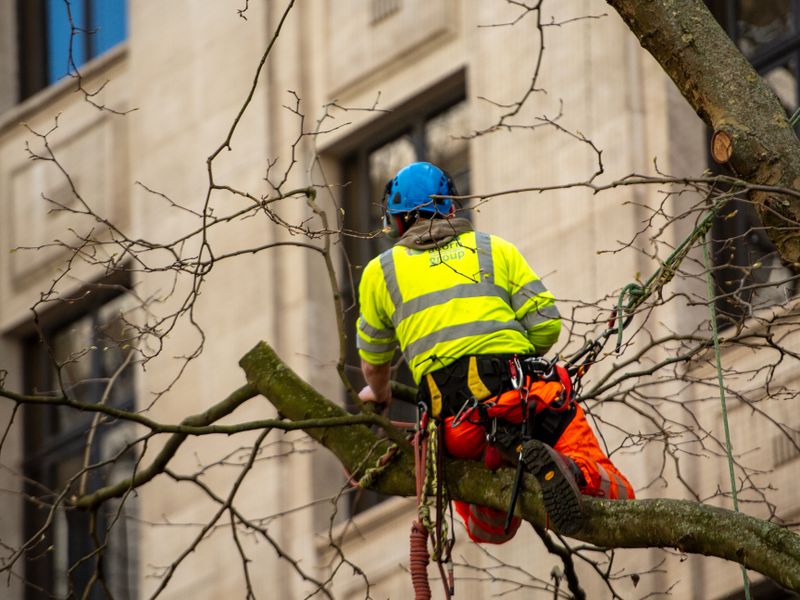
Once a tree grows beyond 5–6 metres, caring for it is no longer a conventional gardening task and requires technique, certified equipment and specific training in arboriculture. In this guide we go over everything you need to know about high pruning: when it is needed, what types there are and how it is carried out professionally in Alicante.
When does your tree need high pruning?
There are several signs that a large tree in your garden needs attention:
- Branches encroaching on power lines, roofs or façades and posing a structural or electrical risk.
- An overly dense canopy that blocks light from the rest of the garden or the house.
- Dead, damaged or diseased branches high up, at risk of falling.
- Unbalanced growth after years without pruning, making the tree less stable in the wind.
- Storm damage, with broken branches or a leaning tree.
Types of high pruning
Not every intervention on a large tree is the same. At Jardines Costa Blanca we distinguish four main types:
- Formative pruning: applied to young trees to guide their growth and prevent structural problems in the future.
- Maintenance pruning: an annual or biennial intervention to control the volume of the canopy and keep its shape.
- Crown reduction: reduces the overall size of the tree when it encroaches on cables, roofs or nearby buildings.
- Sanitary pruning: removes dead, diseased or damaged branches to protect the overall health of the tree.
Techniques and equipment: cherry picker or climbing technique
To work safely at more than 6 metres, arborists mainly use two methods. The cherry picker or aerial work platform is ideal when there is vehicle access: it allows completely stable work up to 25 metres without climbing the tree. When access is limited (small gardens, inner courtyards, trees surrounded by buildings), the climbing technique is used, with dynamic ropes, a CE-certified harness and anchors in the tree itself.
When is the best time for high pruning in Alicante?
In Alicante's Mediterranean climate, most trees are pruned between November and February, during the dormant period, when the tree suffers least from the intervention. Palms are the exception: they can be pruned all year round, although it is best to avoid the hottest months because of the red palm weevil. Emergency work (branches broken by a storm, immediate risk) is carried out at any time of year, without waiting for the ideal season.
Why hire certified arborists
High pruning combines two risks that should not be taken lightly: height and the use of cutting tools. A certified arborist not only works safely but also understands the tree's physiology and knows where and how to cut without compromising its long-term health. If you have a large tree that needs attention, our high pruning service in Alicante works with its own equipment, liability insurance and a free quote within 24 hours.