
 Ver en Español
 Voir en français
 Смотреть на русском
 Bekijk in het Nederlands
 Auf Deutsch ansehen
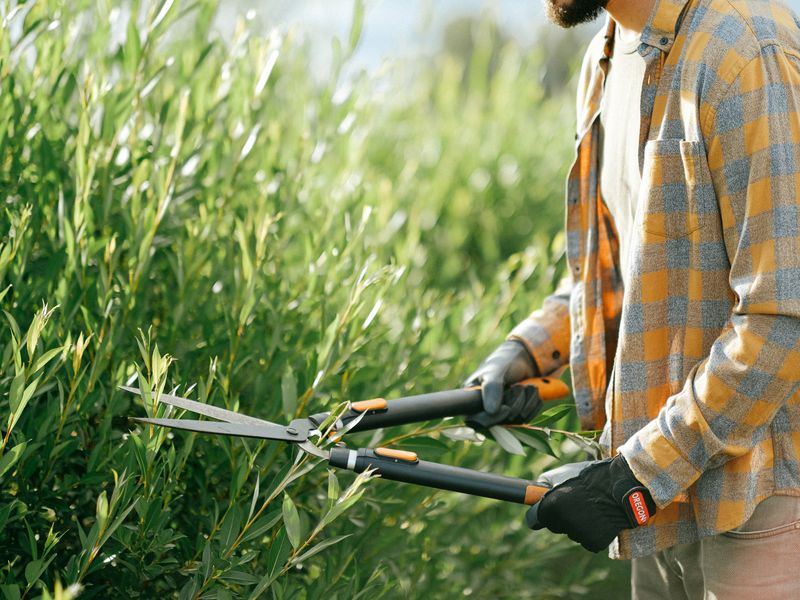
A clean cut doesn't depend only on the hand that makes it: it also depends on the edge at the end of that hand. Blunt secateurs crush the tissue of the branch instead of cutting it, and that ragged wound takes much longer to heal, dries badly and becomes an entry point for fungi and bacteria. In this article we go over how to keep every pruning tool used in a Mediterranean garden in good condition, from hand secateurs to the chainsaw.
Why the condition of the tool changes the result of the pruning
When a tool cuts well, the cut is clean, made in a single movement and at the right angle. The plant closes the wound quickly and the regrowth is healthy. When it doesn't, three things happen at once:
- The bark tears around the cut, leaving dead tissue exposed for weeks.
- The gardener forces the movement, which multiplies the risk of tendinitis, slips and accidental cuts.
- The tool wears out sooner: the blades go out of alignment, the pivot loosens and the edge bends.
Add to that a factor that is rarely taken into account: a dirty tool is a vehicle for disease. If you prune a shrub with a fungal infection and move straight on to the next one without disinfecting, you are inoculating the problem plant by plant.
The routine after every working day: clean, dry, oil
Basic maintenance takes less than five minutes per tool and is what adds the most to its useful life:
- Remove plant debris and resin. Dried sap acts as both glue and abrasive. Remove it with a wire brush and, if it is stuck hard, with a cloth dampened in alcohol or a mild solvent.
- Always dry thoroughly. Blade steel rusts with the slightest moisture, and on the Costa Blanca you have to add the salty coastal air, which speeds up corrosion.
- Oil the blade and the pivot. A few drops of specific oil (or light machine oil) on the blade and pivot point keep the movement smooth and create a barrier against rust.
- Check screws and springs. A loose pivot screw misaligns the blades and ruins the cut; a tired spring forces you to open the secateurs by hand and doubles the effort.
- Store somewhere dry. Never on the floor of the shed or inside the car, where condensation does the rest.
Sharpening: how and how often
Sharpening is the most neglected step and the one that makes the most difference. As a guide, with intensive use a pair of secateurs is touched up every few working days, and with domestic use at least at the start and end of each pruning season.
- One-handed (bypass) secateurs: only the cutting blade is sharpened, on its outer face, keeping the factory angle (usually between 20º and 25º). The anvil blade is not sharpened, only cleaned.
- Loppers and manual hedge shears: same approach, with a medium-grit file or stone and long, even strokes, always in the same direction.
- Pruning saws: most have hardened triple-ground teeth that cannot be sharpened; when they lose their bite, the whole blade is replaced.
- Chainsaw chain: sharpened with a round file of the diameter specified by the manufacturer, respecting the angle of each tooth; the depth gauges must also be filed down every few sharpenings, or the chain will stop biting even if the teeth are sharp.
A clear sign that it's time to sharpen: the tool starts leaving frayed fibres in the cut, or the chainsaw throws out fine dust instead of chips.
Disinfection: the step that stops disease spreading through the garden
Disinfecting between plants is essential when working on diseased or suspect specimens, and highly recommended whenever you move from one species to another. On the Costa Blanca this is especially critical with palms, where a contaminated tool can help spread serious problems such as the red palm weevil and fungi associated with pruning wounds.
- Isopropyl alcohol or 96% alcohol: quick, convenient and gentle on steel. The most practical option in the field.
- Diluted bleach: effective but corrosive; if used, the tool must be rinsed, dried and oiled immediately afterwards.
- Specific garden disinfectants: kinder to the tool and designed for repeated use.
The most realistic way to stick to it is to carry a spray bottle of alcohol on your belt and spray the blade when moving to another plant. It takes two seconds and prevents most infections.
Power tools: chainsaws, hedge trimmers and brush cutters
With motorised equipment, maintenance goes beyond the cutting edge:
- Air filter: clean daily in dusty work. A clogged filter leans the mixture and burns the engine.
- Spark plug: check its condition and the electrode gap; a dirty plug means hard starting and loss of power.
- Chain oil: the tank should empty at roughly the same rate as the fuel; if it doesn't go down, lubrication isn't getting through and the bar overheats.
- Bar and sprocket: clean the groove, check sprocket wear and turn the bar over periodically to spread the wear.
- Chain tension: neither slack (risk of derailing) nor too tight (premature wear and overheating).
- Fuel: two-stroke mix goes stale. It is best to mix small quantities and not leave it in the tank for months.
Getting your tools ready for winter
At the end of the main pruning season, it pays to do a thorough check: full cleaning, sharpening, replacing worn blades, generous oiling of all metal parts, draining the fuel from petrol machines and, for battery tools, storing the battery partially charged in a cool, dry place, never outdoors or next to a heat source. Wooden handles benefit from a coat of linseed oil so they don't dry out or splinter.
Safety: a well-kept tool also protects the person using it
Many pruning accidents are caused by a tool in poor condition: a blade that slips because it doesn't cut, a badly tensioned chain that jumps off, a cracked handle that gives way. Checking your equipment is part of prevention, just like protective gear. If the job involves working at height, the full list of measures is in our article on safety in high pruning.
At Jardines Costa Blanca we work with our own equipment, checked, sharpened and disinfected before every job, precisely because the result of pruning shows a year later, not on the same day. If you would rather leave pruning to professionals, ask for a free quote for shrub and hedge pruning, palm tree pruning or high pruning anywhere on the Costa Blanca.