
 Ver en Español
 Voir en français
 Смотреть на русском
 Bekijk in het Nederlands
 Auf Deutsch ansehen
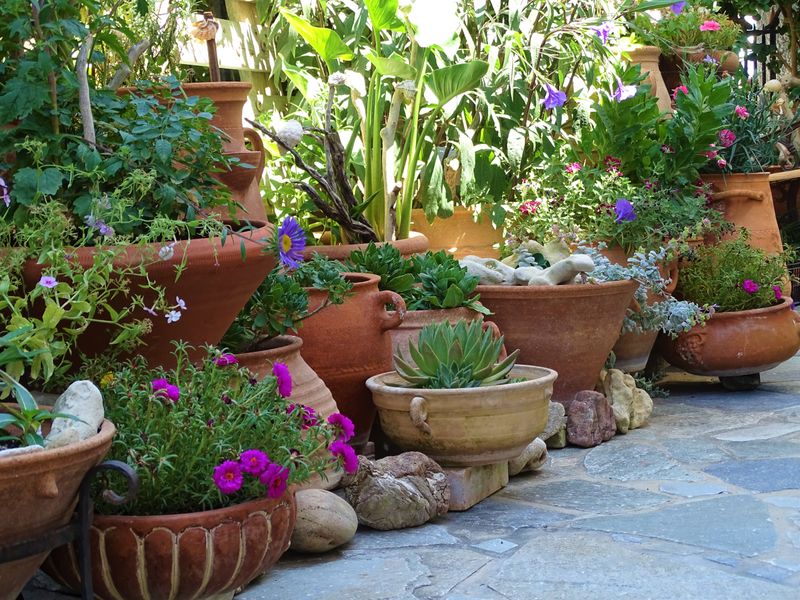
On the Costa Blanca rainfall is low and irregular, summers are long and water keeps getting more expensive. That is why the most effective way to cut a garden's water use is not to water less, but to choose plants that need little water and group them well. A garden like this is still green and full of flowers, but uses a fraction of the water of one based on lawn and species from humid climates.
Here is our selection by plant type, with species we see thriving year after year in gardens from Calpe to Murcia.
Before you start: "low-water" doesn't mean "no water" from day one
Every plant on this list needs regular watering during its first year (the first two for trees) until its roots are established. After that, most are happy with occasional deep watering in summer, and some survive almost on rainfall alone.
Trees
- Olive (Olea europaea): the quintessential Mediterranean tree. It lives on very little water, withstands wind and salt, and a mature specimen gives the garden character from day one.
- Carob (Ceratonia siliqua): native and evergreen with a broad crown, it gives dense shade with hardly any watering once established. It needs space.
- Crape myrtle (Lagerstroemia indica): spectacular summer flowering with moderate watering; very rewarding in small gardens.
Palms and exotic-looking plants
- Dwarf fan palm (Chamaerops humilis): the only palm native to mainland Europe. It withstands drought, wind and poor soils.
- Date palm (Phoenix dactylifera): the symbol of Elche; once mature it tolerates drought very well.
- Yucca rostrata: a sculptural plant with bluish foliage that needs almost no water and looks stunning in gravel gardens.
- Ponytail palm (Beaucarnea recurvata): stores water in the base of its trunk and can go long periods without watering.
- Sago palm (Cycas revoluta): slow-growing and very tough, ideal for large pots and entrances.
You can see all of them at our plant nursery.
Flowering shrubs
- Shrubby germander (Teucrium fruticans): silvery foliage and pale blue flowers; excellent for informal hedges that need almost no water.
- Texas sage (Leucophyllum frutescens): grey leaves and violet flowers after rain. One of the most drought-tolerant shrubs there is.
- Coastal rosemary (Westringia fruticosa): forms compact hedges and copes with the wind and salt of the seafront.
- Gaura (Oenothera lindheimeri): white or pink butterfly-like flowers from spring to autumn on very little water.
- Cape leadwort (Plumbago auriculata): sky-blue flowers almost all year; it appreciates a little extra water in summer but is very tough.
- Lavender, rosemary and santolina: aromatic and almost water-free. We cover them in our selection of aromatic and fragrant plants.
Climbers
- Bougainvillea (Bougainvillea spp.): the most intense colour on very little water; in fact, it flowers better when watered sparingly.
- Cape honeysuckle (Tecoma capensis): orange flowers almost all year, very resistant to heat and drought.
- Star jasmine (Trachelospermum jasminoides): moderate watering, but a perfume that makes up for it.
Ground cover and lawn alternatives
- Thymes and trailing rosemary: cover slopes and areas that are hard to irrigate.
- Lampranthus: carpets of brightly coloured flowers in spring. Avoid, however, the ice plant Carpobrotus, an invasive species that may not be planted in Spain.
- Creeping boobialla (Myoporum parvifolium): an evergreen, white-flowered ground cover that spreads quickly on hardly any water.
- Gravel and decorative stone: combined with these plants, they replace large areas of lawn. If you need a green area for play or sunbathing, first compare artificial and natural grass.
Succulents and cacti
These are the water-saving champions: they store water in their leaves or stems and in our area need hardly any watering. Spineless Agave attenuata is ideal beside paths; aloes (Aloe vera, Aloe arborescens) flower in the middle of winter, and the golden barrel cactus (Echinocactus grusonii) adds a sculptural touch to gravel gardens. They all need very free-draining soil, though: waterlogging rots them.
Watering needs at a glance
| Plant | Type | Summer watering (once established) |
|---|---|---|
| Olive | Tree | Very low |
| Carob | Tree | Very low |
| Dwarf fan palm | Palm | Very low |
| Yucca rostrata | Exotic | Very low |
| Germander and Texas sage | Shrub | Very low |
| Agaves and aloes | Succulent | Very low |
| Bougainvillea | Climber | Low |
| Gaura and Westringia | Shrub | Low |
| Plumbago | Shrub | Low – moderate |
| Crape myrtle | Tree | Moderate |
Very low: survives on rainfall plus the odd watering during heatwaves. Low: deep, infrequent watering in summer. Moderate: regular summer watering, though far less than a lawn.
How to design a water-saving garden
- Group plants by water needs (hydrozones): thirsty plants together on their own irrigation zone, dry-garden plants on another.
- Use drip irrigation with a timer, early in the morning or at dusk, when evaporation is lowest. We can set it all up with our irrigation system installation service.
- Water deeply and infrequently rather than little and often: roots grow deeper and the plant copes better with drought.
- Mulch the soil with bark, gravel or stone: it reduces evaporation, keeps roots cool and holds back weeds.
- Limit natural lawn to the areas you actually use.
- Plant in autumn: with the rains and warm soil, plants root before summer and need less water to establish.
Want a beautiful garden that uses less water?
At Jardines Costa Blanca we design low-water gardens tailored to each plot, from choosing the species to the irrigation. Ask for a free, no-obligation quote for landscaping and garden design, irrigation installation or garden maintenance. And for more ideas, see our 10 low-maintenance plants.