
 Ver en Español
 Voir en français
 Смотреть на русском
 Bekijk in het Nederlands
 Auf Deutsch ansehen
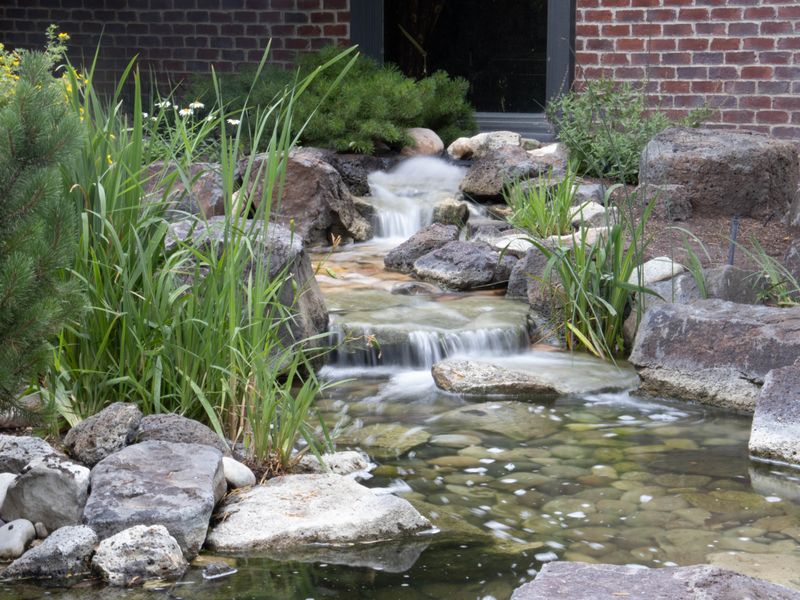
A pond transforms a garden: it brings coolness in summer and the relaxing sound of water, and it attracts dragonflies, birds and frogs. But many ponds end up with green water, bad smells or mosquitoes. The difference almost never lies in chemicals, but in the design: a well-planned natural pond stays clean thanks to its plants and a natural filtration system.
What is a natural pond?
It is a pond that works as a small ecosystem. Aquatic plants and the beneficial bacteria living on their roots and in the gravel feed on the nutrients that algae would otherwise use. The result is clear, balanced water with no need for chlorine or algaecides.
For it to work, the design needs:
- Several depths: shallow shelves around the edges for marginal plants and a deeper area in the centre.
- Enough depth: in our climate the central area should be at least 80 cm–1 m deep, so the water does not overheat in summer.
- Good waterproofing, usually with an EPDM rubber liner protected by geotextile, with the edges covered in stone and gravel.
- A spot with partial sun: a few hours of sun so plants flower, but some shade during the hottest hours of summer. Ideally away from deciduous trees, which fill the water with leaves.
Aquatic plants by pond zone
Each group of plants has a role. Ideally, combine them so that together they cover roughly half the water surface: the shade they provide keeps the water cool and holds back algae.
| Type | Depth | Role | Examples |
|---|---|---|---|
| Marginal plants | 0 – 20 cm | Filter, stabilise the edges and shelter wildlife | Yellow flag iris (Iris pseudacorus), rushes (Juncus), water mint, purple loosestrife, dwarf reedmace (Typha minima), Carex |
| Floating-leaved plants | 40 – 100 cm | Provide shade and lower water temperature | Water lilies (Nymphaea), fringed water lily (Nymphoides peltata), lotus (Nelumbo) in sunny ponds |
| Submerged oxygenators | 30 – 100 cm | Add oxygen and compete with algae for nutrients | Spiked water-milfoil (Myriophyllum spicatum), hornwort (Ceratophyllum demersum), Potamogeton |
| Free-floating plants | Surface | Quick shade while the others grow | Duckweed (Lemna minor) and frogbit (Hydrocharis), always kept in check |
- Water lilies: the queens of the pond. They are planted in baskets with clay soil and flower from May to October on the Costa Blanca. Choose varieties to suit the size of your pond: some spread over several square metres.
- Yellow flag iris and rushes: very tough natives, perfect for the regeneration zone and for giving the edges a natural look.
- Oxygenators: the least showy, but the most important for water quality. Allow a few plants per square metre of surface.
Important: avoid invasive species, which may not be kept or sold in Spain, such as water hyacinth (Eichhornia crassipes), water lettuce (Pistia stratiotes), the water fern Azolla, Egeria densa or Elodea. For the same reason, never release red-eared sliders or mosquitofish into the pond.
Natural filtration systems
In a small pond with plenty of plants, the ecosystem itself may be enough. In medium and large ponds, or ponds with fish, it pays to help it with a natural filtration system:
- Regeneration zone (phytodepuration): a shallow, gravel-filled, densely planted area separated from the open water. Water flows through it and the roots and bacteria remove nutrients. In natural swimming ponds it usually takes up between a third and half of the total surface.
- Gravel biofilter (constructed wetland): a pump carries water to a planted gravel bed set higher up, and the clean water returns to the pond, often as a waterfall or stream.
- Waterfalls and streams: as well as being decorative, they oxygenate the water and keep it moving, preventing stagnant water and mosquito larvae.
- Skimmer: collects leaves and debris from the surface before they sink and rot.
- Low-energy pump, or even a solar one for small ponds, running continuously or on a timer.
In ponds with lots of fish, especially koi, the nutrient load is high and it is usual to combine the regeneration zone with a larger-capacity biological filter.
Ponds in the Costa Blanca climate
- Evaporation: in summer the level drops several centimetres a week. Top up gradually – with rainwater if possible, and if you use mains water, let it stand or add it in small amounts.
- Heat: depth, the shade of water lilies and moving water are the best defences against overheating and lack of oxygen.
- Spring algae: it is normal for the water to turn green for a few weeks as temperatures rise, especially in new ponds. Don't change all the water: the balance returns once the plants get going.
- Mosquitoes: a natural pond with moving water, small native fish and wildlife (dragonflies, frogs, pond skaters) controls larvae on its own.
Basic maintenance of a natural pond
- Autumn: remove leaves and plant debris; if there are trees nearby, a net over the water saves a lot of work.
- Late winter: cut back the dead leaves of marginal plants and divide those that have spread too much.
- Spring and summer: keep floating plants and oxygenators in check so they don't take over the pond, and clean the skimmer and pump regularly.
- Never fertilise the water or overfeed the fish: every surplus nutrient ends up feeding the algae.
Would you like a natural pond in your garden?
At Jardines Costa Blanca we design, build and maintain ponds and water features suited to the Mediterranean climate, with aquatic plants and natural filtration systems. Ask for a free, no-obligation quote for our pond creation and maintenance service or for a complete landscaping and garden design project.